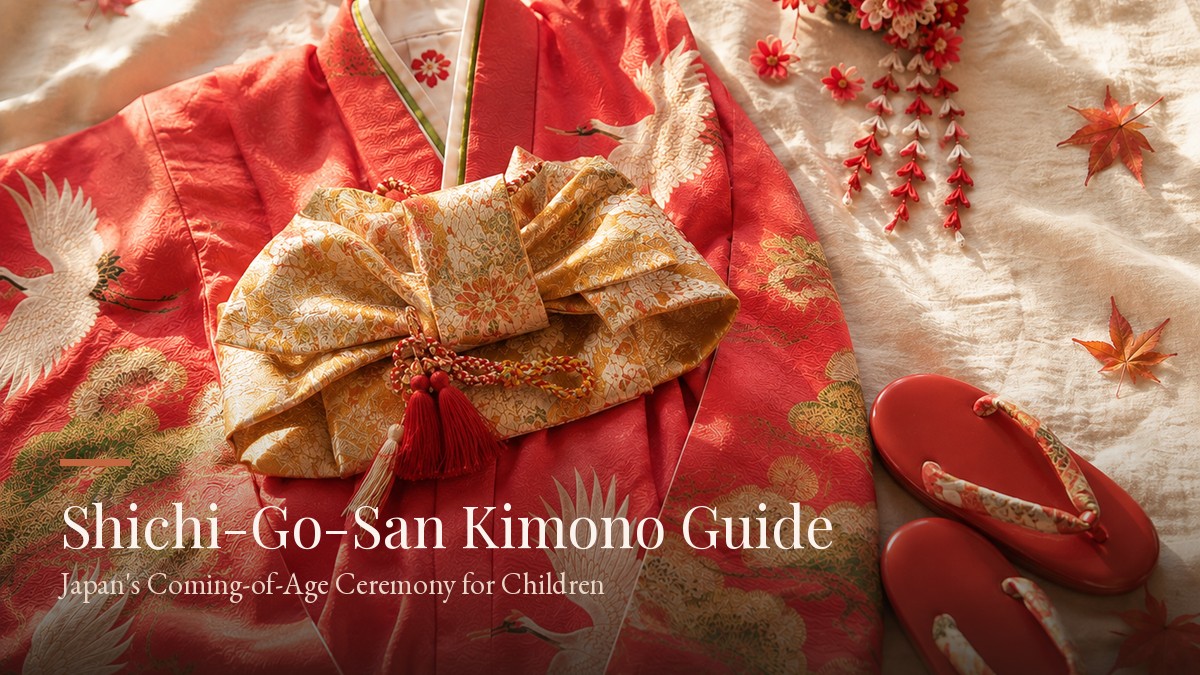
Every November, Japanese shrines fill with small children in kimono far more elaborate than anything they’ll wear again for years — tiny shoulders wrapped in vivid silk, miniature obi tied into perfect bows, parents trailing behind with cameras. This is Shichi-Go-San, and if you’ve ever wondered why Japanese families dress toddlers and grade-schoolers in full formal kimono for a single afternoon, the answer says a lot about how Japan has historically thought about childhood itself.
What is Shichi-Go-San?
Shichi-Go-San (七五三) literally means “seven-five-three” — the three ages at which Japanese children traditionally visit a Shinto shrine to mark their growth. The custom traces back to the Heian and Edo periods, when child mortality was high enough that surviving to these specific ages was genuinely something to celebrate rather than assume. Each age historically corresponded to a specific rite of passage in a child’s dress and status within the family.
The traditional date is November 15, though in practice most families now visit any convenient weekend across October and November, since shrines get crowded and scheduling around a work week with small children is its own challenge. The core of the day hasn’t changed: a shrine visit, a prayer for continued health, and — this is the part that makes Shichi-Go-San visually unforgettable — the kimono.
The kimono, by age and gender
Unlike adult kimono, where the rules mostly track formality and marital status, Shichi-Go-San dress is tied to specific historical rites. The result is that what a child wears actually depends on how old they are and whether they’re a girl or a boy — and the logic behind each style is worth knowing before you’re standing in a rental shop trying to make sense of the racks.
| Age | Who | What they wear |
|---|---|---|
| 3 | Girls | Hifu (被布) — a sleeveless vest-like overlayer worn over a kimono, in place of a tied obi |
| 3 | Boys | Optional, regional. When observed, typically haori and hakama |
| 5 | Boys only | Haori (formal jacket) and hakama (pleated trousers) |
| 7 | Girls only | Full formal kimono with a proper, adult-style tied obi |
Age 3: the hifu
At three, a girl’s kimono is paired with a hifu rather than a tied obi. This isn’t a style choice so much as a practical one — a fully wrapped obi is heavy and restrictive for a toddler, and the hifu achieves a similarly finished look while being far gentler on a small child’s body and patience.
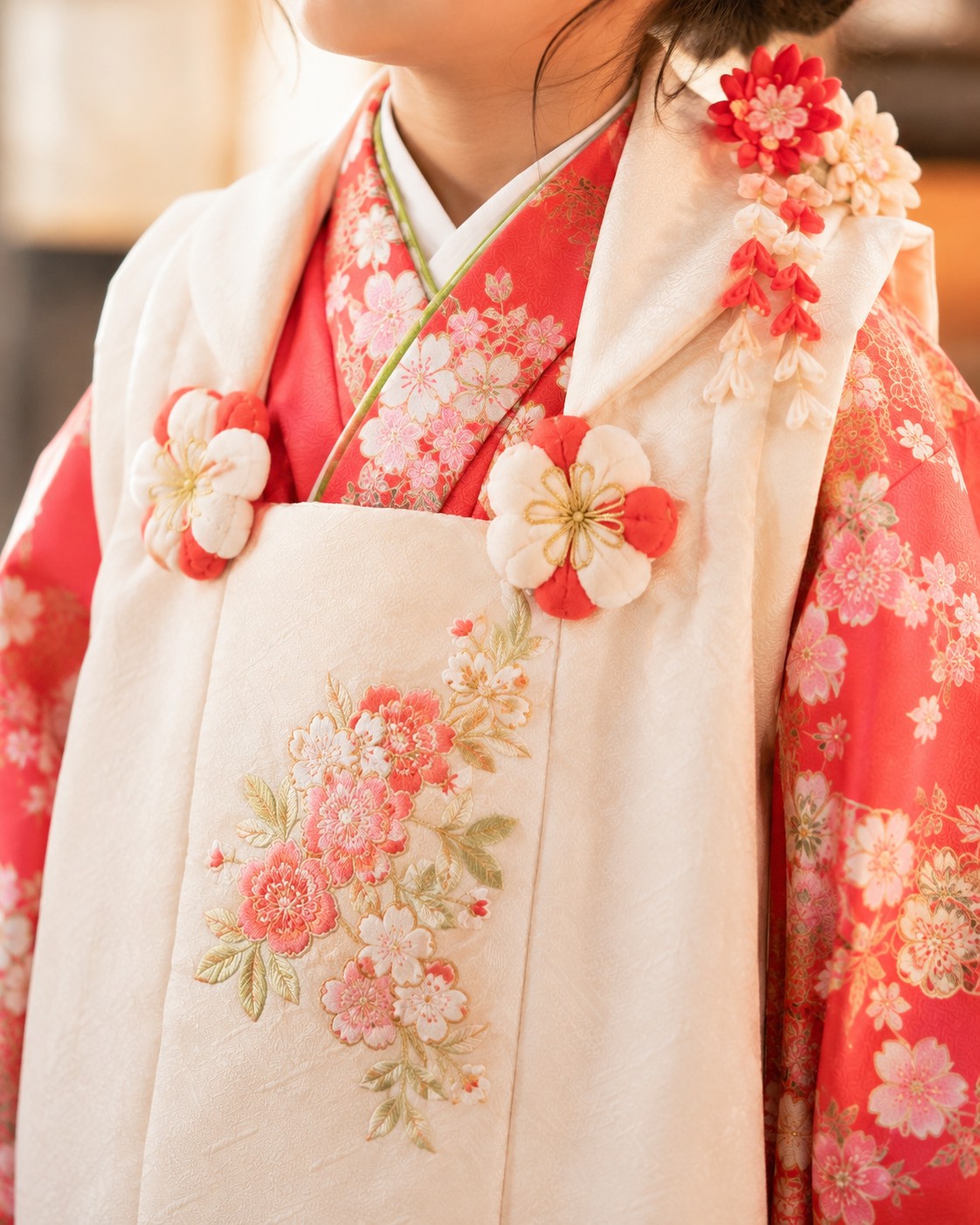
The hifu overlay worn at age three, in place of a tied obi
Age 5: hakamagi, the first hakama
Five is a boys-only milestone, rooted in a historical rite called hakamagi (袴着) — literally “wearing the hakama” for the first time. Before the twentieth century, young children of both genders were often dressed in simple, gender-neutral clothing; hakamagi marked a boy’s formal transition into wearing the same garment structure as adult men. Today’s five-year-olds wear a haori jacket over kimono, paired with hakama, often with a small sword-shaped accessory (kaiken or similar) tucked at the waist as a nod to samurai-era formalwear.
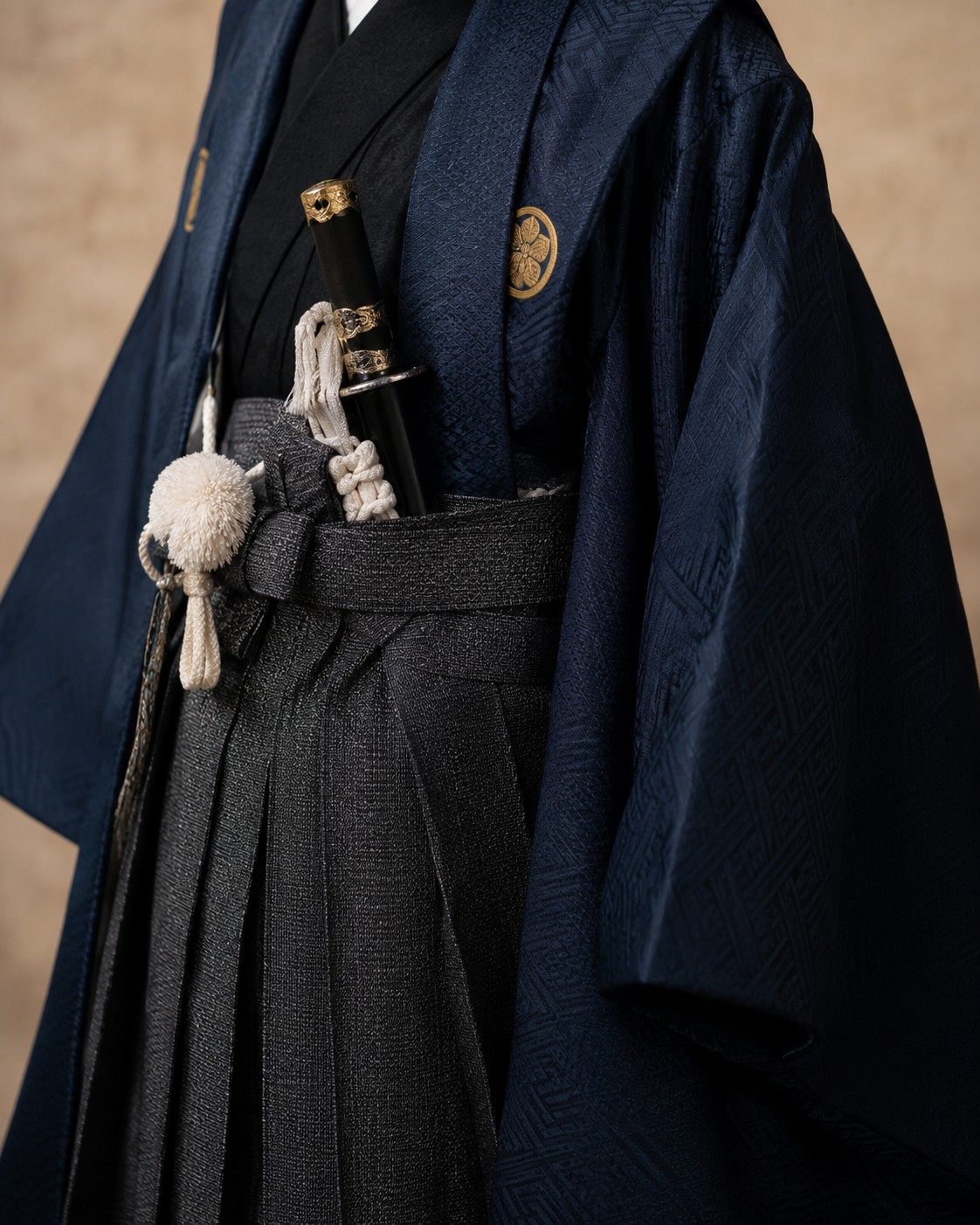
Haori and hakama, worn by boys for the first time at age five
Age 7: obitoki, tying the adult obi
Seven is the girls-only equivalent, and arguably the most visually significant of the three. It marks obitoki (帯解き) — the point at which a girl moves from simplified children’s dress into a kimono closed with a genuine, adult-style tied obi. The kimono itself is typically a yotsumi (四つ身), a child-sized garment cut and proportioned specifically for this age bracket, but assembled and worn with the same structural logic as an adult kimono. If you’ve read our guides to tsukesage or iromuji kimono, the obi-tying principles at play here are the same ones that govern adult formal dressing — Shichi-Go-San is, in a real sense, a child’s first rehearsal for the kimono rules she’ll follow for the rest of her life.
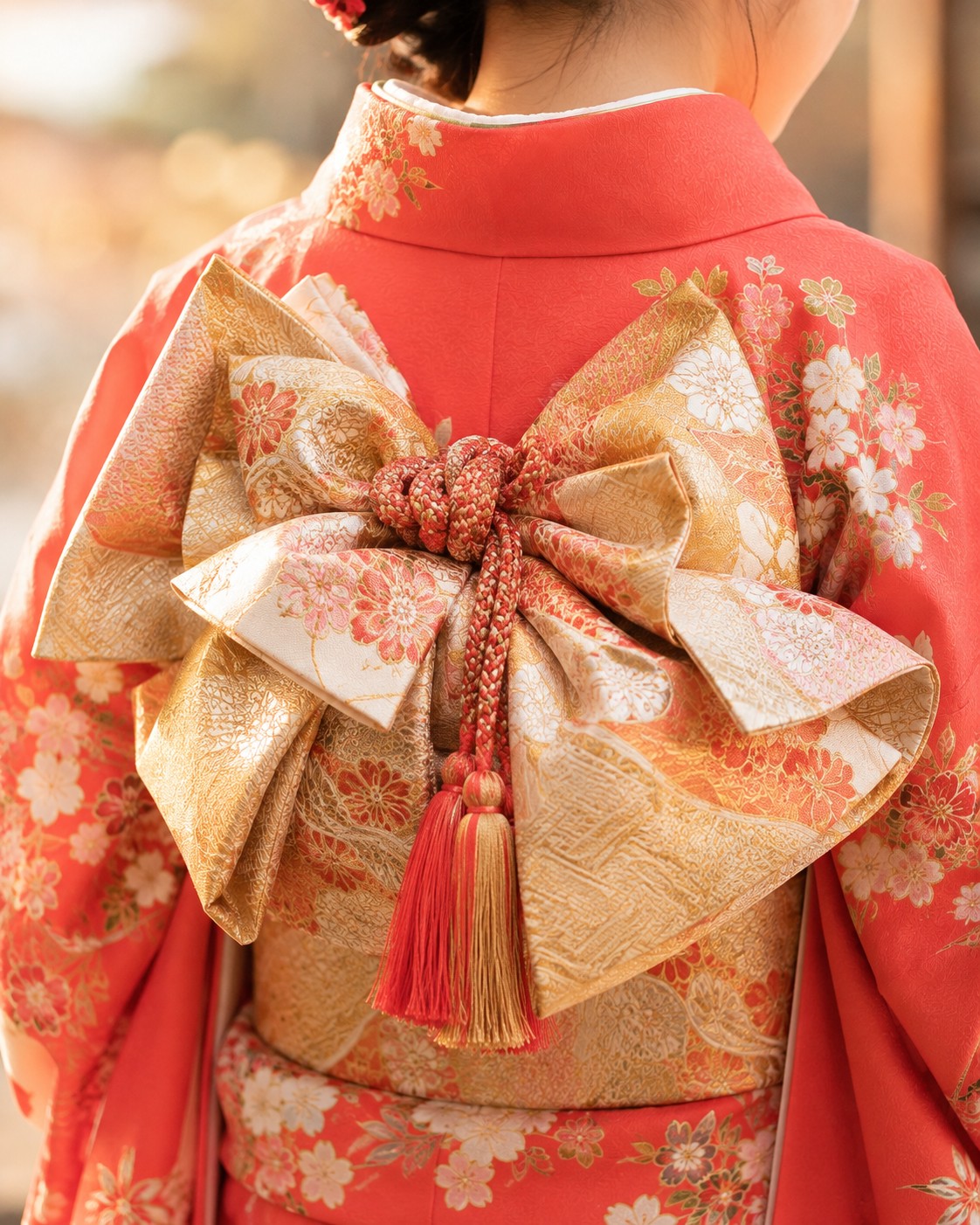
A full, adult-style tied obi, worn for the first time at age seven
Color and pattern: what’s considered auspicious
Shichi-Go-San kimono lean heavily on patterns considered engimono — auspicious, luck-bearing motifs traditionally chosen for celebratory occasions. Cranes (associated with longevity), tortoises, and pine-bamboo-plum groupings (matsu-take-ume, symbolizing resilience and renewal) are common. Bright, saturated colors dominate for girls’ kimono especially — reds, corals, and golds — since this is one of the few contexts where a child’s formalwear is expected to be as vivid as possible rather than restrained.
Buying versus renting
In Japan, renting is the default for the vast majority of families, and the reasoning is straightforward: a child’s Shichi-Go-San kimono fits for one season only, storage space in Japanese homes tends to be limited, and rental packages typically bundle the kimono with hair styling, photography, and dressing assistance — a meaningful convenience on a day that already involves wrangling a small child through several hours of formalwear.
Outside Japan, the calculation shifts. Rental shops specializing in children’s Shichi-Go-San sets are far less accessible, so purchasing — whether new, secondhand, or through overseas resellers — is often the more realistic path. If you’re weighing the two, a few questions are worth asking yourself before deciding: How many times might this actually get worn (a younger sibling, a family friend’s child)? Do you have somewhere reasonable to store it? And is the goal an exact, ceremonially correct version, or an approximation that captures the spirit of the occasion?
What goes with the kimono
The kimono itself is only part of the outfit. A full Shichi-Go-San set typically includes several coordinated accessories, and it helps to know what you’re actually looking for if you’re assembling one piece by piece:
- For girls: obi (the wide sash), obijime (decorative cord over the obi), zori (formal sandals), a small drawstring bag called a kinchaku, and often a decorative hair ornament
- For boys: a haori jacket, hakama, a folding fan (sensu) tucked into the obi, and a small ornamental accessory resembling a short sword or pouch, worn at the hip
Maeodori: the pre-shoot photography culture
One detail that often surprises people outside Japan is that the formal photographs are frequently taken before the actual shrine visit, sometimes weeks in advance, at a dedicated photo studio. This practice — called maeodori (前撮り), “shooting beforehand” — exists largely for practical reasons: studios can control lighting and take their time getting a fussy toddler to sit still, without the added pressure of an actual shrine visit happening around them. It also means families sometimes rent the kimono twice, once for the studio session and once for the shrine day itself, or coordinate a single rental period that covers both.
If you want to try this yourself
You don’t need a three, five, or seven-year-old in your own family to find Shichi-Go-San worth understanding — it’s one of the clearest windows into how a culture marks childhood milestones through clothing rather than words. But if you do have a young relative, godchild, or family friend’s child you’d love to dress this way, or you’re simply drawn to recreating the look, a few starting points: search for “shichi go san kimono set” through overseas kimono resellers rather than adult rental platforms, which won’t carry children’s sizing; expect full sets (kimono, obi or hifu, accessories) rather than piecing one together from separate adult-kimono retailers; and if a fully authentic set isn’t accessible, a simplified version — a hifu-style vest over a plain kimono-inspired dress, paired with the right colors and a few of the accessories above — still captures the occasion’s spirit far better than generic “Asian-inspired” costuming would.