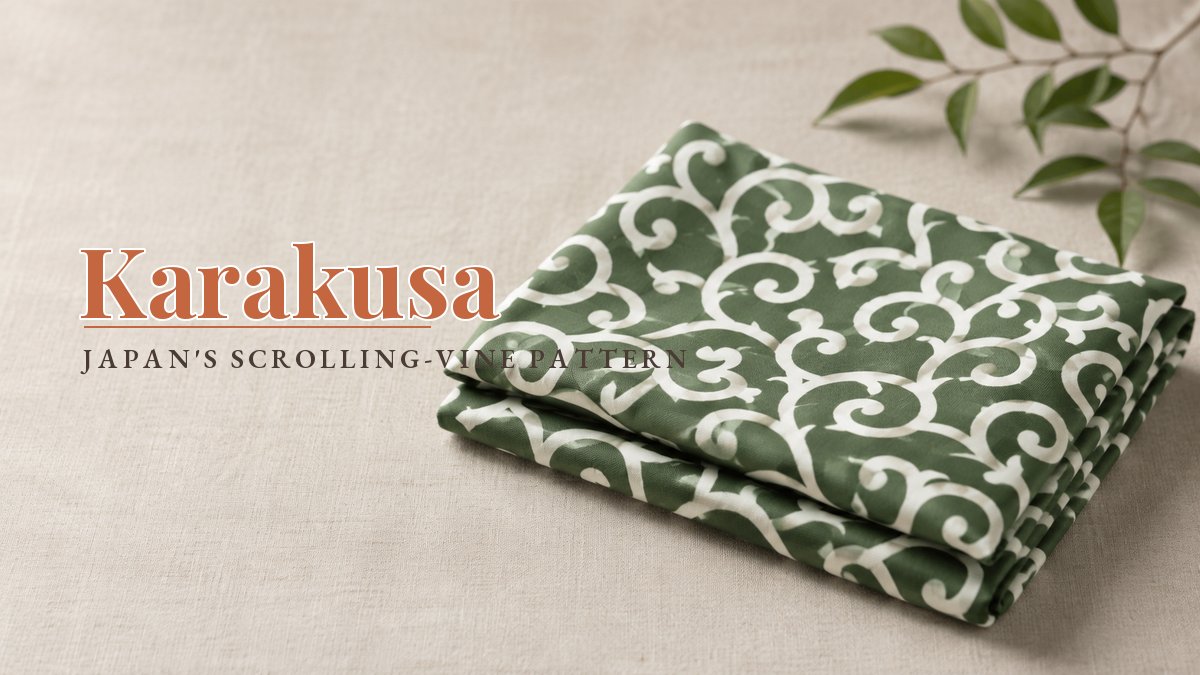
You have almost certainly seen the karakusa pattern — those endless white vines curling across a deep green cloth — without knowing its name. It wraps gifts, drapes over kimono, and in Japan it even has a reputation as the fabric of cartoon burglars. Behind that playful image sits one of the oldest travelling motifs in the world, a single vine that never stops growing.
What Is the Karakusa Pattern?
Karakusa (唐草) literally means “Tang grass” or “Chinese grass.” It is not one specific plant but a stylised, continuous vine — scrolling tendrils that twist, curl, and branch across the fabric with no beginning and no end. The design is built from repeating S-curves and spirals, often studded with small leaves or blossoms.
The name points to China, and the motif did reach Japan through China — but its roots run much deeper and much farther west. What makes karakusa special is that unbroken line. Because the vine appears to grow forever, it became a quiet emblem of continuity, and that single idea shapes almost everything people came to read into it.
What Does the Karakusa Pattern Mean?
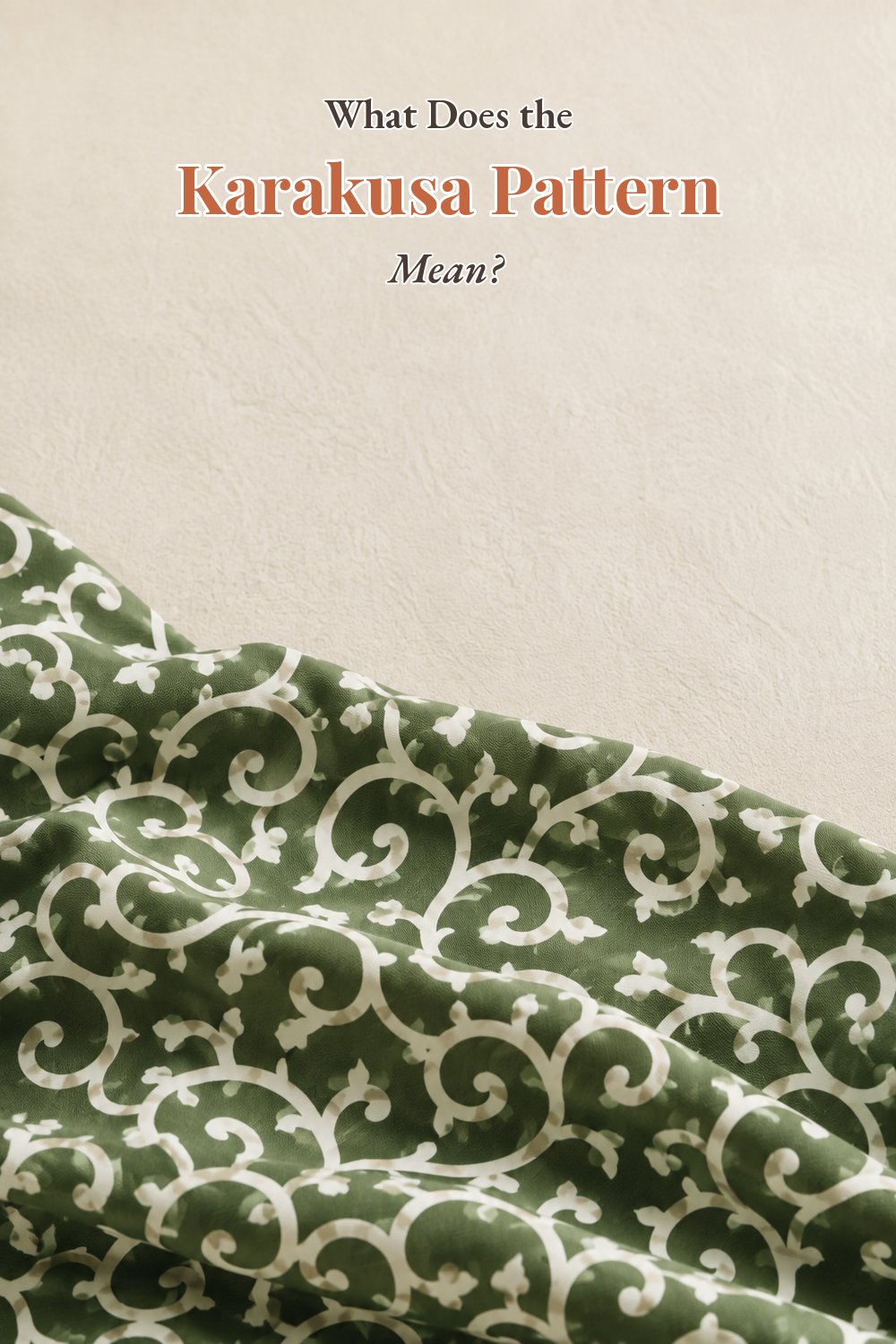
Most of karakusa’s meaning grows out of that one visual fact: the vine never breaks. From there, three ideas are commonly attached to it.
- Longevity. A vine that keeps growing suggests a long life and enduring health.
- Prosperity. Vigorous, spreading growth is read as flourishing fortune.
- Descendants and family continuity. Tendrils that branch and multiply are linked to a family line carried on through the generations.
It is worth being clear about what kind of meaning this is. These readings are symbolic associations that grew up around the pattern over time — not a fixed code that every wearer consciously intends. A karakusa kimono is not a literal wish spelled out in thread. But because these associations are so widely shared, karakusa has long been considered a graceful, auspicious choice for gifts and celebrations.
Where Did Karakusa Come From?
Here is the surprising part: karakusa is not originally Japanese, and it is not originally Chinese either.
Scrolling-vine ornament is one of the great wandering motifs of the ancient world. Versions of it appear in ancient Egypt, Mesopotamia, and Greece, where stylised vines, palmettes, and acanthus leaves decorated temples and pottery. Along the trade routes we now call the Silk Road, that vine ornament travelled east — through Persia and Central Asia, into China, and finally to Japan.
By the Nara period (8th century), the motif had firmly arrived. Among the treasures preserved in the Shōsōin repository in Nara — a storehouse of eighth-century objects — are textiles and objects carrying scrolling-vine designs. So when Japan named the pattern “Tang grass,” it was crediting the route the design took to get there, even though the vine had already crossed half the world before reaching China.
The Three Faces of Karakusa
Because karakusa is a vine rather than a single flower, artists could graft almost any blossom onto it. The same scrolling backbone carries different flowers, and each variation picks up its own layer of meaning.
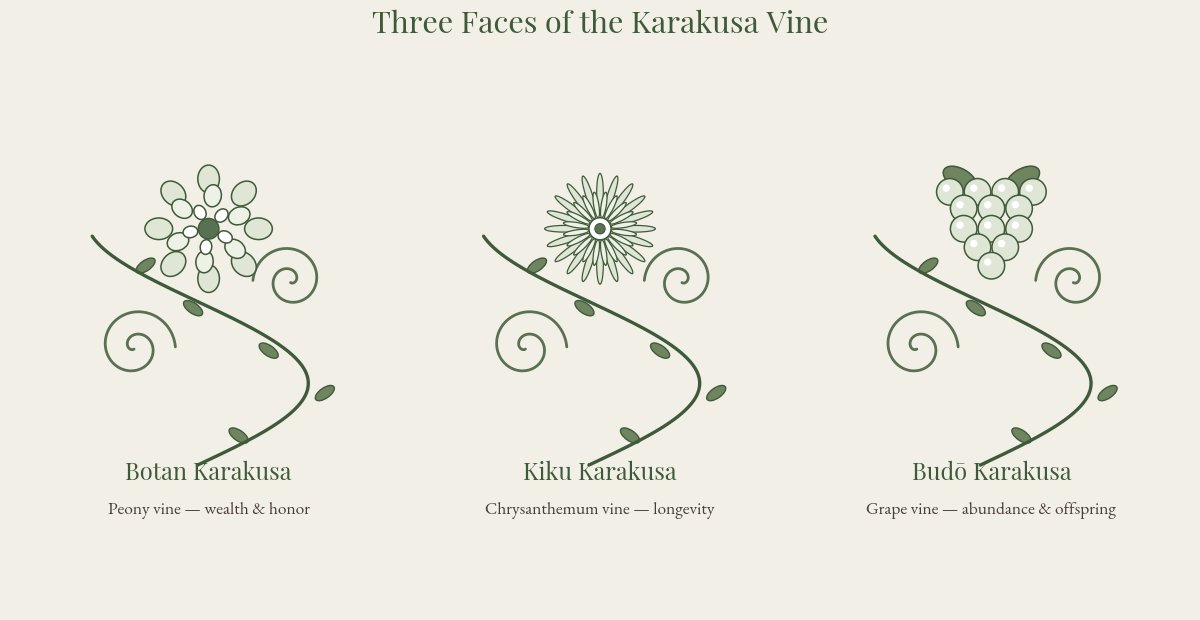
Botan Karakusa — Peony Vine
The peony is often called the “king of flowers,” associated with wealth and honour. Set on a scrolling vine, it turns karakusa into one of the most opulent, formal versions of the motif.
Kiku Karakusa — Chrysanthemum Vine
The chrysanthemum carries strong associations with long life. Paired with the endless vine, it doubles down on the theme of longevity that runs through karakusa as a whole.
Budō Karakusa — Grape Vine
Grapes, with their heavy clusters of fruit, are linked to abundance and to many descendants. The grape-vine version is one of the older forms and appears among those early Silk Road imports.
You may also meet hōsōge karakusa — a vine bearing an imaginary, idealised flower that never existed in nature. It comes from Buddhist art, and it is a good reminder that karakusa was always as much about pattern and rhythm as about any real plant.
Why Japan Thinks of Burglars
Now for the pattern’s funniest twist. Ask many Japanese people about a green-and-white karakusa cloth and they will smile and think of a thief.
This is a modern association, not an ancient one. From the Meiji era onward, inexpensive green-and-white karakusa furoshiki (wrapping cloths) became a fixture in ordinary households — so common that nearly everyone owned one. In twentieth-century manga, anime, and comedy, the stock image of a burglar became a figure hauling a swag bag knotted from exactly that cloth. The look stuck.
So the “burglar’s furoshiki” is a piece of pop-culture shorthand from the last century or so — charming, widely understood in Japan, and completely separate from the pattern’s older, auspicious meanings. For an international reader it is simply a fun bit of trivia; it carries no such association in the West.
How to Wear Karakusa
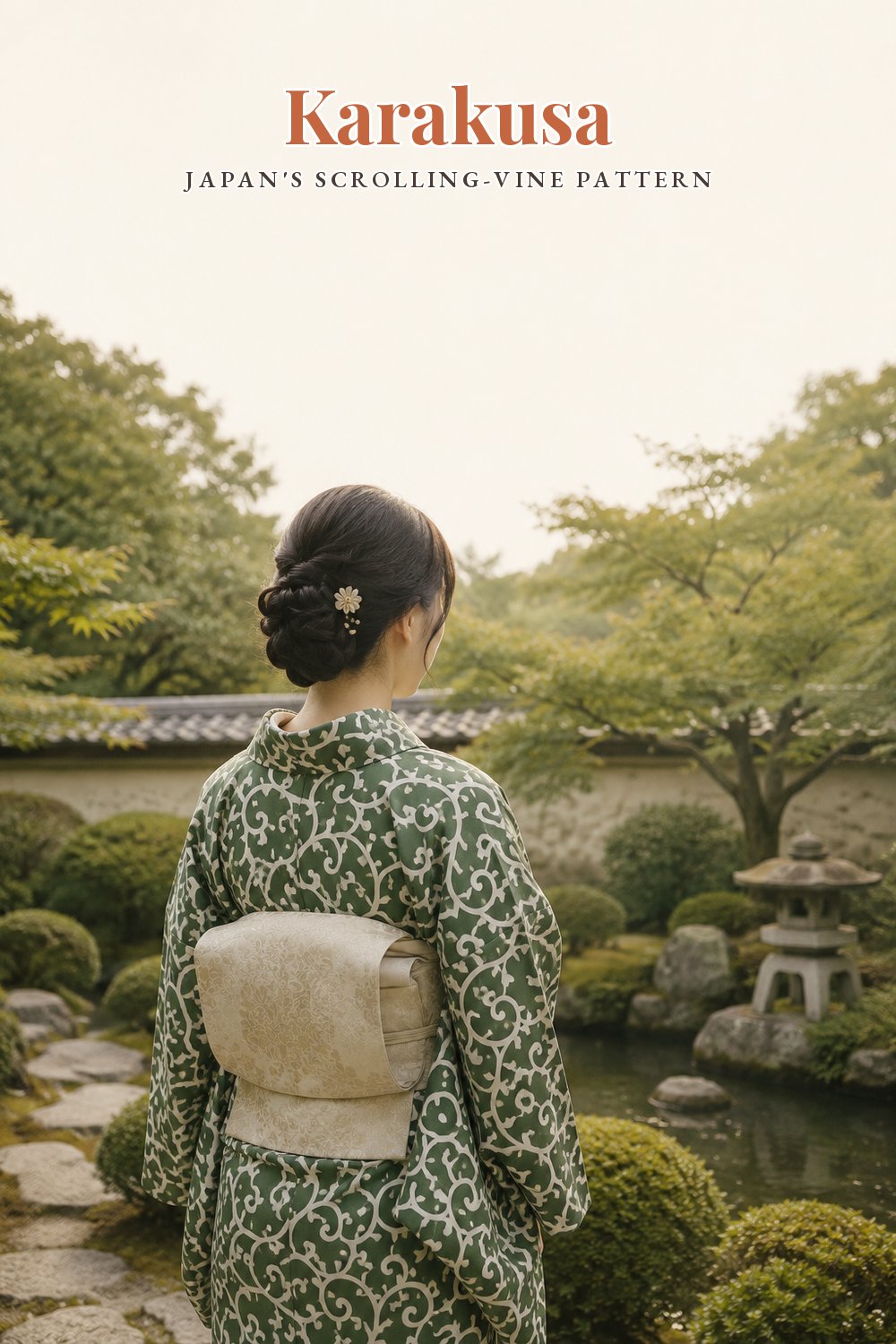
Karakusa is wonderfully versatile. Because it is an all-over, non-directional pattern with no strong seasonal tie, it works comfortably across the year — unlike motifs locked to cherry blossoms or autumn leaves.
- Kimono and yukata. A green-and-white karakusa reads as classic and a little playful. Deep indigo or black grounds feel more formal.
- As an accent. If a full karakusa kimono feels bold, start with a karakusa obi, a han-eri collar, or a small bag — the scrolling line adds movement without taking over.
- Beyond dress. Karakusa lives happily on furoshiki, tenugui hand towels, tableware, and home textiles, which is an easy way to bring the motif into daily life.
My own feeling: karakusa is the motif I reach for when I want something that feels both traditional and quietly optimistic. That never-ending line is, in the end, a very kind idea — growth that simply keeps going.
Frequently Asked Questions
Is the karakusa pattern originally Japanese?
No. The scrolling-vine motif traces back to the ancient Near East and Mediterranean and travelled east along the Silk Road through China before settling in Japan, where it became extremely common. The Japanese name “Tang grass” reflects the China route rather than an origin.
What does karakusa symbolise?
It is most often associated with longevity, prosperity, and family continuity — all drawn from the image of a vine that grows without end. These are traditional symbolic associations rather than a fixed rule.
Why is karakusa linked to burglars in Japan?
That connection is modern. Cheap green-and-white karakusa wrapping cloths were once in almost every home, and twentieth-century manga and anime turned that cloth into the classic burglar’s swag bag. It is pop-culture humour, not old tradition.
Can I wear karakusa in any season?
Yes. Karakusa has no strong seasonal association, so it is considered a year-round motif — one reason it has stayed so popular for centuries.